Wednesday

Buying Kettlebells

"I want buy kettle bells", was the words of a friend mine Simon Chandler who wanted to get himself and his family into some exercise. Simon knows me as a fitness trainer under my business name of Stay Slim and Avoid the Gym, and approached me around a year ago wanting to get into regular exercise. A year ago I got Simon onto some of the basics with some structured cardiovascular training and some nutritional advice. Simon came back recently to me for some advice on buying kettlebells as he wasn't sure which size, make or even the best place to buy them from. I gave him the recommendations he needed and off he went. This Scenario gave me the idea behind my post today  to give people advice on what kettlebell size to get and a place to buy them from. 


Standard Cast Iron Kettlebell
Kettlebells range from 4kg-alway up to 40kg, going up in weight increments of 4kg, so you got 4kg, then 8kg, then 12kg and so on typically, and there are 3 main types of kettlebell. There is the cast iron kettlebell which are commonly used in the health and fitness industry, although they are not always made of cast iron it is recommended you do buy the cast iron one as it will last you a life time. The only thing that can really go wrong with it is that the paint does chip away sometimes especially if used outside on concrete and begins to rust slightly.  To overcome this you can buy a kettlebell that comes with a rubber casing around he bottom of the kettlebell which protects the paint work and cast iron. 
Vinyl Coated Cast Iron kettlebell


Competition Kettlebell


The second type of kettlebell is the competition kettlebell, more expensive than regular cast iron one as its made of stainless still and the way it is made. The competition kettlebells are made to a standard size regardless of the weight. So the 4kg will be the same size as the 40 kg, what they do is the 4kg is a hollow shell and they make the skin of the shell more thicker to increase the weight of the kettle bell. The reason for the competition kettlebells being the same size but a different weight is that if the kettlebells are smaller in size it will travel through the air faster than a kettlebell that is bigger. All it does is standardised the air resistance during the swing on all weights, although you will gain a training advantage from this, its not  essential. One big advantage they do have being stainless still it will never rust. 


Weight Adjustable kettle bell


The 3rd type of kettlebell are ones that have adjusting weight plates on them so you can change the weight of the kettlebell. This is great if you don't want to own lots kettle bells to save on storage space. The main draw back is that you have to keep changing the weight as where if you own a set of kettle bells you can just pick hop another kettle bell.


So whether you are complete beginner to kettle bells and exercise or the more experienced exercise here is the complete guide on what kettlebells to get.


The 4Kg Kettlebell


4kg Kettlebell
In terms of kettle bell training the 4kg does not do a great deal for the body overall as kettlebell training is about the swing movement which works the Thighs, Glutes, lower back and abdomen. However I do own a few myself as they are great for isolation exercises such as bicep curls, tricep extensions and lateral raises.


The 8kg Kettlebell


8kg Kettlebell

The 8kg is a great starter kettle bell, its good a good weight for swing and can also be used for other compound work too like squats and shoulder press. You can also use it for isolation exercises such as bicep curls, tricep extensions and lateral raise.


Check out how to purchase


The 12 kg Kettlebell


12 kg Kettlebell

The 12 kg kettlebell is a good one to add to your set as you will quickly become use to the 8kg on most of the compound exercises such as squats, swing, cleans, and the snatch. It will take a bit longer with the more advanced moves such as the turkish get and windmill along with many isolation exercises like bicep curls.


Check out how to Purchase


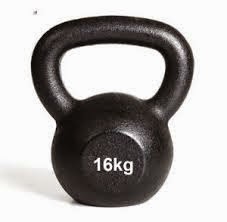
The 16 kg Kettlebell


16 kg Kettlebell


The 16 kg kettlebell is good for some who is naturally strong and wants to get into kettlebell training. You should add this to the starter set too as you maybe able to do some of the main compound exercises such as dead  lift, squat and two handed swing. For exercises such as bicep curls and shoulder press the 16 kg maybe be difficult for novices to intermediate levels of strength training.


Check out how to purchase


The 20 kg Kettlebell


The 20 kg would be more suitable for a person who has been using the 8kg,12kg,16kg for 3-6 months and now finding those weights unchallenging. If someone has been weight/strength training for a longtime then they should also be ok the 20kg kettle bell. The 20 kg kettlebell may not be suitable for the majority people for isolation exercises such as single arm  bicep curls and tricep extensions. If you are at starter level and you do want to purchase a 20 kg kettlebell for your kettlebell set then this will be fine as you can use it for squats and dead lifts


Check out how to purchase


The 24kg Kettlebell


The 24 kg is a weight that is really for the intermediate-advanced level kettle bell user or someone who has a history of strength training. The 24 kg ketltebell is going to be mostly used for your compound movements such as squats, dead lifts, one arm rows, two handed and singlehanded swing, cleans, and snatch. Experienced lifters could use the 24kg kettlebell for shoulder press, bicep curls and tricep extensions.


Check out how to purchase


The 28kg Kettlebell


The 28 kg kettlebell is for the more experienced kettlebell traininer and weight lifter. A lot of people could well dead lift or squat with a 28kg kettlebell. However the swings, snatch or cleans will only be able to be done by more experienced kettlebell users.  An experienced lifter or kettlebell trainer should be able to shoulder press this weight and use it for one arm rows. The 28 kg kettlebell is not much use for for single isolation works such as one arm bicep curls, unless you are an very experienced to elite lifter/athlete. 


The 32kg Kettlebell


Check out how to purchase


The 32 kg kettlebell is most likely going to be used solely for compound exercises by most people such as the dead lift or squat. However using it for the swings, cleans and snatches are for very experienced kettlebell users. The isolation exercises are going to be very difficult with the 32 kg kettlebell and  should only be attempted by very experienced or elite lifters.


The 36kg and 40kg Kettlebell


Check out how to purchase

Check out how to purchase


The 36 kg & 40 kg kettlebell fall into the same category in many ways, again most people may well be able to some compound training with these weights  such as dead lifts and squats. If you are able to swing these two handed you are doing very well. If you are doing a single hand swing or even the clean and or the snatch then you have well and truly mastered the art of kettlebell training. Shoulder press and one arm rows of the 36&40kg kettlebell is possible for the advanced weight trainer.


Monday

Cardiovascular Training

Cardiovascular training is a form of physical activity that raises that heart rate and breathing rate above resting level. Cardiovascular training focuses on one of the two energy producing path ways the body has. The first energy pathway is the Anaerobic energy supply where the body does not need Oxygen. After a few minutes of exercise the body then moves into the aerobic energy system where you will notice an increase in your heart rate and breathing. This is because for any exercise that takes longer than 2-3 minutes the muscle fibres needs oxygen to continue to exercise. There are a variety of ways that you can manipulate your cardiovascular training to gain further increases in your cardiovascular fitness. After about 20 minutes of exercise all the muscle fibres being used will predominately be using the Aerobic energy pathway. It may switch back to the Aerobic pathway if you suddenly increase your speed or if you meet a hill during your cardiovascular training session. There are 3 main types of Cardiovascular training which you want to incorporate into your training plan to develop high levels of cardiovascular fitness. These are Long Slow Distance (L.S.D for short), Pace/Threshold and Interval.

With regards to what type of exercise to do whilst training your cardiovascular system, it doesn't really matter what form of exercise you do. Do something you are comfortable with whether its running, swimming or anything that involves equipment such as a bike, rowing machine and cross trainer. 

Long Slow Distance (L.S.D)


A bike can be cardiovascular 
Long slow distance training is about increasing endurance, pace is almost irrelevant as the aim is to cover as much distance as you can. If you are new to Long Slow Distance training you can start out by doing as little 5-10 minutes, then you want to increase your time to 15 minutes and so on. You can also focus on the distance variable, walk for one Kilometre then increase it to 1.5 Kilometre and so on. How far you want to go with this is entirely up to and how far you body will allow you to go, however you can cover some tremendous distance if you put your mind to it and your body as enough fuel on board to cover the energy demand.  If exercising for hours on end does not appeal do you then you can use then you need to move onto pace and threshold training.


Pace and threshold Training

Running can be Cardiovascular
Pace and Threshold training will help you to decrease the time it takes you to complete a set distance. For example if you have managed to walk 2 kilometres in 30 minutes, you will need to increase pace to cover this distance in a faster time.  A great way to begin with this is simply time yourself it takes to walk one kilometre, then try and beat that time the next time you do it. When you are doing pace training you want to be able to second split, this is simply completing the second half of your distance quicker than the first half. If you were going running for 2 Kilometres, you would want to do the second Kilometre quicker to get the fastest time possible as you want to be running at your or near your Threshold going into the later stages of your run. Your threshold is your ability to maintain your fastest pace without stopping. If you begin to feel you legs are going jelly like and when you are breathing there is a burning feeling you need to slow it down and after 2-3 minutes you should be ok. This is effectively interval training when you go to fast and slow down, this is not necessarily a bad thing as it will help to increase you aerobic power.

Swimming can be Cardiovascular

Interval Training 


Interval training is good to improve Aerobic power and sports performance, it helps the body to recover faster and develop speed. There are no set rules on how you should plan out your intervals, along as they are challenging. You can do them for as long as you want during a training session, i would personally recommend to start out doing 20 minutes increasing to about 45 minutes as your fitness improves. Then your intervals can be done in ratios, a good starting ratio is 2 minutes of fast running with 4 minutes of walking. As your fitness improves the exercise periods can increase and rest/walking periods decrease (3 minute run 1 minute walk). You can make your intervals specific to your sport or activity. If you play an intermittent sport like squash, you may sprint for 10 seconds rest for 5 jog for 15 etc. The main focus is on volume,  recording the distance you cover during your cardiovascular training. 


Getting A Road Bike

So, i have decided that running is starting to grind down my old bones to much now i am approaching the big old 3…0 … and have decided to give road cycling a crack. After coming to the decision of this i needed to get my first bike and decide how much money i was willing to spend. From looking around at bikes, some second hand and some brand new it seem that i would probably need to spend up to a £1000 to get started. I looked at second hand bikes on Ebay and i did not feel confident in buying a used bike as i would not be able to determine if there was anything mechanically wrong with it or if it was even the correct bike for me. 

So I opted for a new one 

Giant Defy 2 Compact XL Frame
I was getting impatient, tired of running and losing motivation with my cardiovascular training as a result of this so I acted quickly. I live around the corner from a a shop called “Tri UK” in Yeovil and decided this will be a good starting point. Tri UK  has a huge amount of stock with a variety of brands of well known bike manufactures in there such as Giant, Scott, Trek and much more. The range of bikes in there is massive from low budget all the way to the serious cyclist or Tri Athlete. The guys in there were very helpful, after chatting to them about my situation and and my budget they recommended that I start with the Giant Defy Compact 2. I opted for the 20 speed as anything less around this area would struggle on the hills when out cycling. So the man I brought the bike from, Christian said that it was best I come in to have a fitting done on my new bike so  i  would  be set up and ready to get cycling. Prior to the fitting, I needed to get the essential accessories to get started, I was going to need a helmet (Zerorh+, zw blue), pedals (Exlistar) with cycling shoes (Foor) and shorts (Zeroh+ White, Red and Black). After selecting the ones I liked that are within in my budget, I was ready to get started with my fitting. The fitting is not necessarily essential but it will give you a good understanding of the best way to set up your seat and handlebars for your body size. They take  measurement from the floor to your crutch to work out the best place for you to be seated. They get you on the bike and get you cycling with bike attached to a turbo roller to see your riding technique. During this time they give you some cycling pointers and make any adjustments to the bike if needed. Then you are good to go and give it a go for your self outside.

Zeroh+ ZW Road bike helmet

RH + Cycling Shorts


My First few rides

I kept my first few rides local, riding through my local cycle paths, quite roads and country lanes. This is just so I could get use to to the bike and get a better understanding of how the mechanics of the new bike. Starting with flat surfaces I then progressed onto some small hills to try out the gears and brakes. Once my cycling confidence improved I started to increase my distances starting of at about 10 mile round rides and now working at 20-30 mile round rides. The reason I took it steady to begin with was I wanted to gain confidence cycling with clip on shoes as this was completely new to me.


Clip on Shoes


Foor size 11 Clip on Cycling Shoes
The clip on shoes take some getting use too, I start with clipping my left  foot in whilst stationary then cycling a few metres before clipping the right foot in. Always clip in your dominate/strongest leg first as this will help with powering away from a stationary position. When coming to a stand still you just have to remember to un clip one of your feet so you can safely put one foot on the floor to balance you and the bike before you stop. If you don't do this then you will topple over,  which I have managed to do twice which created some amusement for pedestrians and car drivers. Im glad I went with the clip on shoes despite the few early hiccups. Cycling with clip on shoes give me far more control of the pedals and helps to generate more speed and power whilst cycling.


Exlistar Clip on Pedals 


The Gears

Having rode mountain bikes when I was younger, I didn't feel the gears would be to much trouble. Having said that the gears on a mountain bike and road bike do seem to slightly differ. The Giant Defy compact 2 comes with Shimano Tiagra gears. The best way to understand the gears which seems to work well for me is gears 1-10 (front crank on small cog, back cog big is gear one and smallest cog is ten) work best on flat and up hills. Gears 11-20 (Front crank/cog is at the top, then back big to small are 11-20)  work best on down hill to flat and cycling on flats where the tarmac is nice and smooth. As cycling fitness and power increases, the gear ratios used will change, i tend to keep the front Crank/cog high and use gears 11-20 for most of the ride  now as I can comfortably go up small hills/gradients in 11th gear. Then i go back down to gears 1-10 when the hills get steeper or if i am unable to get a good run up to the hill.  
Shimano Tiagra Gears and Cranks


Brakes, Tyres and Punctures.

Draper Mobile Tool Kit
Brakes on the Giant Compact Defy 2 are great, they are quick to break and they are easy to adjust too. The tyre pressures need to be regularly checked, i keep them at recommended maximum of 120 Psi. This is the optimal pressure that will allow you to cycle faster with less risk of a tyre blow out. You can have it higher than 120 psi (although not recommended by the tyre manufacture, which will make you go faster however the risk of a tyre blow out does significantly increase.With choice of tyre pressure its worth bearing in mind the conditions of the roads/paths you cycle on. If you are finding the ride to bumpy, then lower the tyre pressure, this will help you with handling the bike. Ideally you want to avoid the bumps and holes as best as you can so if you ride about 2-3 feet away from the kerb, the tramcar here is a lot smoother. Body weight also plays a part in tyre pressure, the lighter you are you can run at a lower tyre pressure too. Always take a puncture repair kit and small bike pump with you, as i found out the other week 2 miles is a long walk with cycle shoes on! I brought a small mobile Draper bike repair kit which does the job perfectly and bought Red Devil self adhesive patches. The draper kit does come with patches but they are not particularly great. The rest of the kit is fantastic, there is small pump, tyre levers and a small tool set which is in the style of a swiss army knife which allows me to make adjustments whilst i am out and about cycling. 
Draper Kit attached to the bike

Pump, Tyre Levers, Puncture Patches, and Tools.


I can see how cycling as a hobby/sport can become very expensive, which I wouldn't say is a bad thing as spending money on something that is a great lifestyle choice is a positive move. I can definitely see myself upgrading my bike in the future whether thats just small upgrades on my current bike or buying a full carbon frame bike. If you just want to get into cycling just as a hobby and don’t want to spend to much money, then you really can get a lot for under £1000. This level of spending will be an ‘entry level’ bike if you did want to enter Triathlons and road races, so if you did want to take it more seriously the giant Defy Compact 2 is a great starting bike,

Wednesday

Tough Mudder, How Tough Is It

Im so pleased to finally get round to doing this race and getting back to blogging. I have been majorly busy starting up my own brand of health and fitness Stay Slim and Avoid the Gym which has been a major focal point and success in the last 18 months of my life. During this busy time I have managed to take time out to try out new exercises and challenges, one being the Tough Mudder.

Here we are all at the start (Im the one in the Yellow t-shirt). 
So on Saturday the 12th of July 2014 at 9.00 am I was in Kettering doing the Tough Mudder course with some friends I have made since I have started out on my adventure with Stay Slim and Avoid the Gym. In fact I think it was after a very short time of knowing them they had me signed up to this crazy and yet fun race. On completion we all agreed that it was not as tough as we though it would be. However we were all still very happy to complete a gruelling cross country run with some fun and sadistic obstacles along the way.


Here are my top 5 obstacles (In no particular order) during the course, along with some advice on how to tackle them.  


1) Glory Blades (climbing over 6-7ft wall slanted at bout 10-20 degrees) 
Picture Of Glory blades

I was not looking forward to these and my heart sank a little when I saw they were the first obstacle. To my amazement I completed them with little trouble. As it was the first obstacle of the run we had plenty of energy to throw our selves over. There were a few reasons why I was worried about this obstacle. During my training i found it hard to replicate this obstacle, I did some pull ups and a lot of upper body retraction work ( lateral rows and bent over rows) to help with being able to pull my body weight up.  I also  done some plymoteric training to help improve the power of my jumps. However finding a  slanted wall at around 6-7ft tall was not possible. Worse case scenario if you did struggle there are only 2 walls to clear and there are fellow mudders on hand to help you over.

2) Arctic Enema (diving into ice cold muddy water and swimming under a tyre barrier)


Freezing Fun
This obstacle took me by complete surprise, I have never really been one to worry about a bit of cold water being British. However I have never experienced anything like this. Despite it being ice cold the water is mixed with a lot of mud and god knows what else by the smells! (very farm like!). Anyway I jumped in and initially felt fine, then  started to hyperventilate. Which at the time was scary and I didn't think I was going to be able to swim under the tyres. It was a very hot day by British standards and we had been running for a few miles prior to reaching this obstacle. The rapid change in body temperature didn't react well with me so I had to find away to overcome it. I realised that my head was still really hot and the rest of my body is now cold and this was what was probably causing me to hyperventilate. So I had to start throwing the lovely cocktail of muddy ice water over my head to get my body to adapt to the cold. After about 10 seconds of doing this the hyperventilation passed by and i swam under the tyres with no trouble. Training wise I didn't feel there was much I could do for this one, apart from having a cold bath from time to time which i didn't do! If you were to take it very seriously then an ice bath right after your training session could help you with this one. Practising holding your breath under water may help but to be honest you are not under water for very long, 5 seconds at the most.

3) The Electric Eel. (army crawl through muddy water with electric wires hanging down)

It as painful as it looks
You sometimes here a lot in training "mind over matter" which I never really followed, but this really
was an instance when this applied. I said to my self " its probably only as strong as electric fence wire that they use to keep cows in a field which is unpleasant but its certainly not going to hurt you". How wrong was I to be. I took the sound advice of the marshals of just go through it as quickly as you can. So i just dived straight in and army crawled as quickly as possible and things were going well, I haven't got shocked yet. I bobbed my head from side to side to avoid getting hit in the face with any of the wires which worked really well. Anyway right at the last 2 metres (roughly 5-6 metres of crawling) I felt a shock go right through my body, I think my bum made contact with the wire. Then i got another 2 shocks, one on my hip ,then one my shoulder right at the end. The shocks just seem to freeze you for a split second. Oh yeah the shock is definitely worse than that you get from an electric fence keeping cows or horses enclosed  The only training you can do for this is get quick at doing army crawls. I practiced them in a field going up and down slopes and just working on my speed with these. There is no training that can help with the electric shocks unfortunately :-0.

4) Everest (running up a half pipe/big skating ramp).
Im the  One in the Middle being helped up

This one worked out ok for me, did it first time but did need a little help. I was not sure how to tackle this whether to try and make it up myself or get help. Looking back I think I could have done it ok with out anyone helping me. However when you do your run up there are a lot of people waiting up the top to give you a hand, so i opted for a little help as a appose to jumping on them.  There are 2 ways you can tackle it, either go slow and steady and try not to slip. The other is just to keep sprinting as fast as you can and don't think about stopping or slowing down, because when you change speed thats when people tend to slip and fall back down the half pipe. The good thing is that you can train for this. One is to go to your local skate park and run up the half pipe ramp. Second (the way I trained) was just to focus on hill sprints and jumping jacks. These type of exercises will help you develop explosive power to help accelerate at the half pipe.

5) Hero Walls (Climbing up a 9t wall)
The Hero Wall, Tough.

Unfortunately I was not much of a hero at this one, Steve in our group manage to clear them with
relative ease. He said his days in the Army helped with jumping over the walls, and he is very good at lifting his own body weight too, which unfortunately for me I am not. This was going to be a struggle, I opted to be helped over by my group and other mudders, which to be honest a lot of people did as its probably the safest thing to do this far into the race for your own safety. This is a tough one to train for, you will need to work on building your upper body pulling and retraction strength, so your pull ups, Australian pull ups and any Latisimuss Dorsi works outs are going to help. You also need to develop spring in your legs so the Pyometric training will be beneficial too. However it is very hard to replicate climbing over a 9ft wall. I did get chance to try out some 6-7 ft walls but those few extra feet make a big difference.

Would i do it all again?

Absolutely, i am currently planing my next exercise challenges. I would  like to do the Tough Guy race which is apparently more difficult, according to a friend of mine who use to run them back in 2008 and he actually won the tough guy race.  So I am currently recruiting a team to do that with me next year hopefully, any takers?  In the mean time I have recently purchased a road bike, which I am really enjoying and hope to enter a race in the near future. 

You do get a free pint at the end that goes down nicely!

Here I am preparing for take off to everest 


Friday

The heavy weight champ of exercise classes? Boxercise


After recently attending a Boxercise class at 1610 in Yeovil, Somerset, UK  I would say that this is personally one off my favourite classes, the question that still remains, is it the best class? There are many benefits to this class, it's great for the upper back, core, legs and arms, awesome for cardiovascular conditioning and most importantly it is a fun class and that's what keeps people coming for more . However tho, the class does have its draw backs as boxing is very much a skill in itself, it is even referred to as a science by some of the respective names in the sport (sweet science of boxing). In short, whether Boxercise or boxing training is good for someone will not depend on how coordinated or skilled one is, but rather their outlook on the nature of the boxing as a sport.


The term "sweet science" is a good term to understand when referring to boxing, the best way to understand this is to simply ask your self, what do you see when watching boxing? Is it two barbaric people with an  aggressive nature trying to inflict damage on each other, or is two craftsman at work using there skills and ability to out wit each other. The best way to compare boxing is to a game of chess, tactics and strategy along with the ability to adapt, will play the largest part in how successful you will be. Boxing is an art form, you can go and find the most aggressive person in the world, put that person against another person who is the same weight who is not aggressive but has been trained in the skills of boxing, the boxer will come out on top every time when pitted against competing in the boxing ring . A good example of this would be the "raging bull " Jake Lamotta (the aggressor ) and his showdowns with Sugar Ray Robinson, a better known example would be Ali and Frazier.


Whether Boxercise is the right class for you will depend on your outlook and interpretation of the sport of boxing, after reading this (if your weren't already ) you can see past the thuggish side of the sport and it has far more to offer than aggression,  which actually makes up a small part of the sport when you begin understand the true nature of boxing. There are few work outs that can compete with putting on those boxing gloves, peppering jabs onto the pad or bag, followed by twist in the torso for the cross shot, leading into hook punches and getting the legs involved when powering through the uppercuts. Boxing or Boxercise will allow you to leave the stresses of life on the indents made on the pads or punch bags. 

Tuesday

H.I.T The Circuits (High Intensity Training)

Circuits Class


Last week I had the chance to get back to the class room floor, as I got the chance to instruct the Thursday evening circuits class at the centre I work at.  The circuit was made up of 9 stations and a running track. The nine stations covered a range of resistance workouts , covering upper and lower body, core and abdominal and some shuttle runs to work on speed and agility. The class was an hour broken down into three three rounds on the nine of the station, first was thirty seconds on a station followed by a thirty second run, second was one minute on each of the nine stations and then after a little break the last  one minute on the station followed by one minute running. The main benefit of the circuits class is an overall body work out at a level of high intensity a lot like the Boot camp class.


One might be asking why put yourself throughout such a tough work out class, one is high intensity training also know has H.I.T training has many Health benefits, and you can use this class to improve physical and/or sporting performance. If you want to get a sweat on, get results, get fit, then start HITting the circuits class.

Wednesday

High intensity exercise is believed to improve congnitive function

A study  presented to the Canadian Cardiovascular congress has discovered that high intensity training on a regular basis can improve cognitive function. The discovery found that improved blood flow to the brain through exercise improves the function of the brain, this can include improved memory and sharpness. This links into a previous post i did focusing on energy drinks to overcome tiredness, instead of consuming an energy drink, do some brisk exercise to get blood flowing to the brain. Hopefully this discovery can help open more research into  how a physically active lifestyle can improve our over all health, as appose exercise being one of its more well known uses of being a vanity thing to look like a celebrity or to get in shape for you next vacation.